Bőrlevél. A bőrlevél (Bergenia) a kőtörőfűfélék (Saxifragaceae) családjába tartozó, Közép-Ázsiában, Afganisztánban, Kínában, a Himalája térségében őshonos 10 fajt számláló nemzetség. A nemzetséget Karl August von Bergen német botanikusról és orvosról 1794-ben nevezték el Bergeniának. (https://hu.wikipedia.org/wiki/B%C5%91rlev%C3%A9l)
.jpg) |
| https://upload.wikimedia.org/wikipedia/commons/e/ea/Bergenia_cordifolia_(Inflorescens).jpg |
Seed - surface sow in a greenhouse. Make sure that the compost does not dry out. Two weeks cold stratification can speed up germination which usually takes 1 - 6 months at 15°c[134]. Fresh seed, sown as soon as it is ripe in late spring is liable to germinate better than stored seed. When they are large enough to handle, prick the seedlings out into individual pots and grow them on in light shade in the greenhouse for at least their first winter. Plant them out into their permanent positions in late spring or early summer, after the last expected frosts. Division in late spring after flowering[188] or in autumn[200]. Very easy, larger divisions can be planted straight into their permanent positions whilst smaller clumps are best potted up and kept in a cold frame until they are growing away well.(http://www.pfaf.org/user/Plant.aspx?LatinName=Bergenia+crassifolia)
Bergenia cordifolia. A useful ground cover plant, though rather slow to spread[200]. It forms a clump[208]. Tannin is obtained from the bark[223]. On a 10% moisture basis, the roots contain 14.5% tannin and the leaves 10.5%[223]. (http://www.pfaf.org/user/Plant.aspx?LatinName=Bergenia+cordifolia)
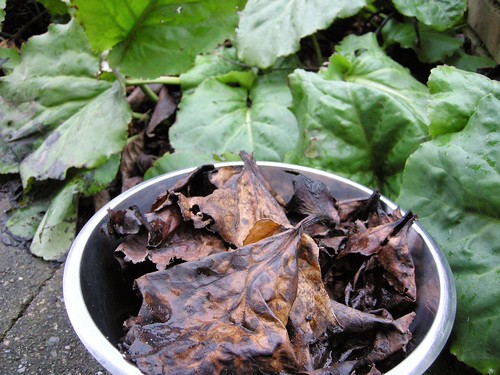
Mongolian tea. Mongolian tea is naturally, on plant, fermented leaves of Bergenia crassifolia (syn. Bergenia cordifolia). It is used in Mongolia and Siberia, where Bergenia crassifolia grows in the wild. The leaves are collected when the snow melts in the spring. [...] In Siberia and Mongolia is not unusual to drink mongolian tea. I can remember the taste. I definitely got this tea served in Siberia, thinking it was ordinary chinese black tea. Nobody told me I was wrong. The taste is gentle and pleasant.(https://toads.wordpress.com/2016/02/04/time-for-mongolian-tea/)
 |
| https://farm2.staticflickr.com/1560/24188854103_fa85e49603.jpg |
Bőrlevél életpálya. Az itt leírt tapasztalatok és kísérletek tíz éve indultak. Orosz vendégünk a mikkeli (Finnország) intézetben az udvar végében díszlő hatalmas bőrlevélágyás láttán felkiáltott: Nocsak, nálatok is nő a szibériai tea? Az általunk addig csak dísznövényként ismert évelő ettől kezdve új értelmet kapott: gyógynövénykísérletek, több program és új történet izgalmas alanya lett. (http://kerteszetesszoleszet.hu/hu/irasok/borlevel-eletpalya)

Nincsenek megjegyzések:
Megjegyzés küldése